What is a KOT? Kitchen order tickets explained, with a hospital example
KOT stands for kitchen order ticket: the slip or screen that tells a kitchen what to cook, for whom and by when. Here is the classic format, how it changes in a hospital diet kitchen, and sample tickets you can adapt.
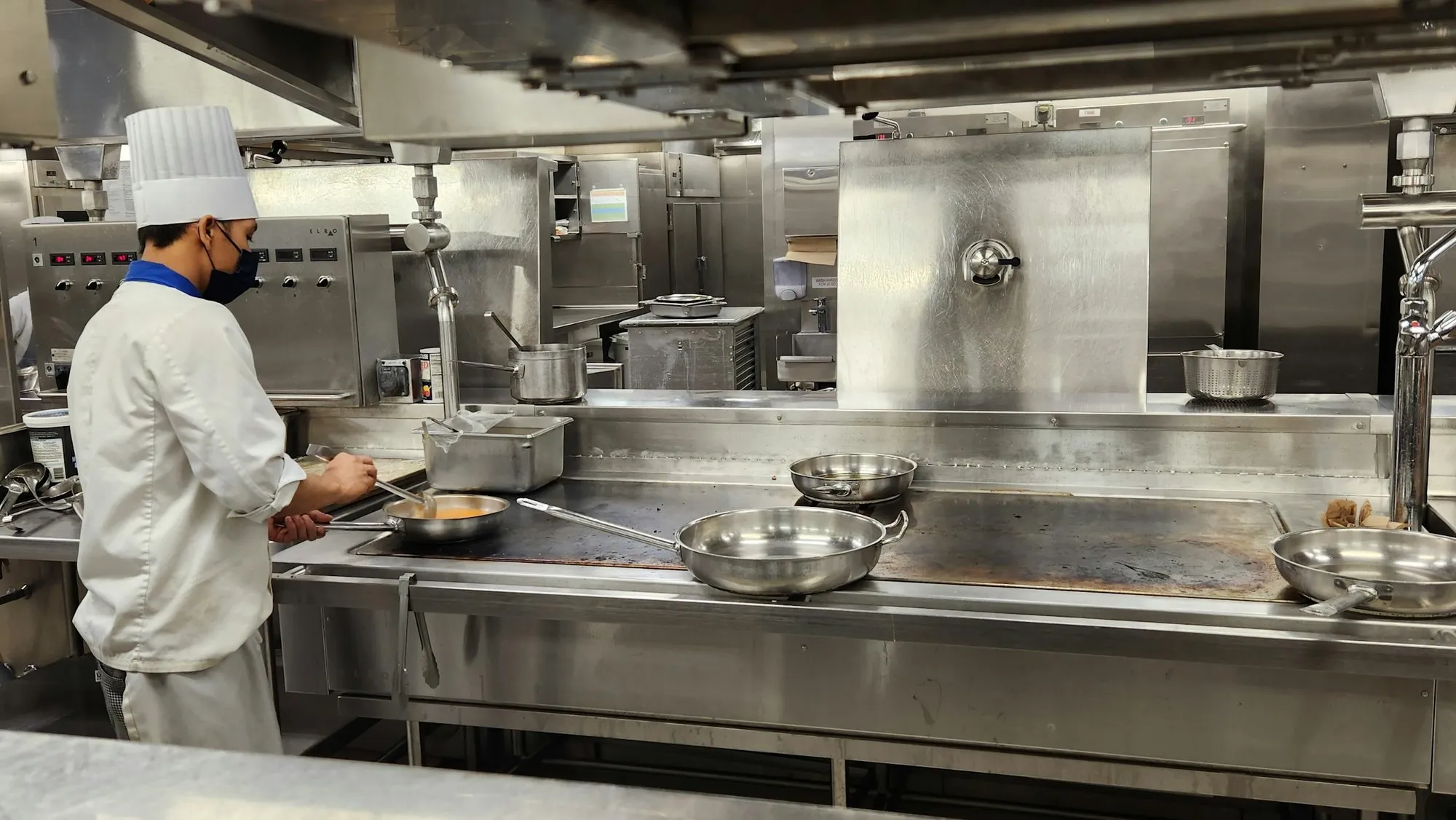
A KOT (kitchen order ticket) is the printed or on-screen instruction that tells a kitchen what to prepare, how many, for whom and by when. It links the person who takes the order to the cook who fills it, and it is the record the bill is checked against. In a hospital, the same ticket also has to carry the ward, the bed, the patient’s diet and the meal slot, because a wrong tray is a clinical error, not just a service one.
KOT full form and meaning
KOT stands for kitchen order ticket. Depending on the kitchen, you will also hear it called a kitchen ticket, an order chit or a food check. Bars usually run a separate ticket for drinks, often called a BOT (bar order ticket), so that beverages can be controlled on their own.
A KOT does three jobs at once:
- Communication. It tells the kitchen exactly what to cook, in what quantity and with which changes, without anyone shouting across the pass.
- Control. Every KOT carries a serial number, so each dish that leaves the kitchen can be matched to a bill.
- Record. It is a time-stamped trail of what was ordered, by whom and when. That matters when a guest disputes a bill, or when a patient’s family asks what was served at dinner.
For a short definition you can share with your team, see our glossary entry on KOT.
What is the KOT format? The fields that matter
Hotel management courses in India teach the KOT as part of a sale control system. Course notes from the Institute of Hotel Management, Bhubaneswar describe the classic food check: the server fills in the table number, number of covers, date and their signature, and every check is serially numbered. A modern point-of-sale system prints the same fields automatically.
| Field | What it is for |
|---|---|
| KOT number | A running serial, so every ticket can be traced and matched to a bill |
| Date and time | Shows the order sequence and how long a ticket has waited |
| Table, room or bed | Tells the runner where the food goes |
| Covers | The number of guests, which helps the kitchen pace and portion a table |
| Items and quantities | What to cook |
| Notes or modifiers | Changes such as “less spicy” or “no onion” |
| Station | The section that cooks it: tandoor, curry, tawa or cold kitchen |
| Server | Who took the order, for accountability |
Notice what is missing: prices. A KOT is an instruction to cook, not a bill. Here is a typical restaurant KOT:
KOT No: 1047                     Date: 25-09-2026
Time: 13:12                      Table: 7    Covers: 3
Server: Ravi                     Station: Tandoor, Curry
======================================================
Qty  Item                        Note
2    Butter roti
1    Paneer tikka                less spicy
1    Dal tadka
1    Jeera rice
======================================================
Printed at: Kitchen printer 1
How a KOT system works
The manual triplicate system
In the traditional method taught in hotel schools, the order is written on a pad that makes three copies. According to the IHM Bhubaneswar notes, the top copy goes to the kitchen and is handed to the aboyeur at the pass, the second copy goes to the cashier who makes out the bill, and the third copy stays with the server for reference during service. Smaller outlets often use a duplicate version with two copies. Any cancelled or altered check is signed by the head waiter or a supervisor.
That design is about control. The kitchen only cooks against a ticket, and the cashier only bills against a copy of the same ticket, so the two can be reconciled at the end of a shift. Food that left the kitchen without being billed shows up as a gap.
Special KOTs
Real service is messy, so most KOT systems include a few special tickets:
- Supplementary KOT for items added to an order already in progress.
- Cancellation KOT for items no longer needed, signed off by a supervisor.
- Replacement or no-charge KOT for a dish that has to be remade. The IHM notes describe this as an “accident” check, marked no charge and signed by the supervisor in charge.
Digital KOT systems
In a digital KOT system, orders are entered on a point-of-sale terminal, tablet or phone. The system prints tickets at a printer in each section or shows them on a kitchen screen, keeps the serial numbers, and links every ticket to the bill. The principle has not changed since the carbon pad. The copying and the carrying are what disappear.
How a KOT works in a hospital
Hospital kitchens run on the same idea with more at stake. The ESPEN guideline on hospital nutrition treats hospital food as part of medical treatment and recommends that hospital food ordering be structured, documented and protocoled. The IHM notes even list the hospital tray system as its own order-taking method: meals are pre-ordered rather than ordered at the table.
Orders reach the diet kitchen from ward rounds, where staff take bedside orders on a tablet (often called RSOT, room service order taking), and from families ordering their own attendee meals. Every patient order has to respect a diet order set by the treating doctor and dietitian. That changes the ticket:
| Restaurant KOT | Hospital KOT | |
|---|---|---|
| Who orders | The guest, at the table | Staff on ward rounds, the patient or family, or an administrator, always against the patient’s diet order |
| Where it goes | A table number | A ward and bed, plus a second identifier such as name or UHID |
| What limits the order | The menu and the stock | The diet order, texture and allergies, and holds such as NPO before a procedure |
| Timing | Cooked when ordered | Cooked for fixed meal slots with cut-off times |
| Grouping | One ticket per table | One ticket per patient, rolled up into production tickets per station |
| Handover check | The server’s memory | The meal card checked against the patient at the bedside |
| Billing | Bill at the table | Covered by the room tariff or package, added to the final bill, or paid by the attendee |
Sample hospital KOT: one patient, one meal slot
KOT No: L-0412                   Date: 25-09-2026
Meal slot: Lunch                 Printed: 11:05
Ward: 3B Medicine                Bed: 14
Patient: A. Sharma               UHID: 00012345
Diet: Diabetic, low salt         Texture: Soft
Allergy: Peanut
Station: Diet kitchen, hot line
======================================================
Qty  Item                        Note
2    Phulka                      no ghee
1    Moong dal                   thin consistency
1    Lauki sabzi                 no added salt
1    Plain curd
======================================================
Ordered by: RSOT, ward round 09:40
Deliver by: 12:30                Check: meal card vs bed and UHID
This is sample data. The items illustrate the format and are not diet advice: each patient’s therapeutic diet is set by the treating doctor and dietitian.
Every line has a job. The ward and bed tell the runner where to go. The second identifier stops the tray reaching a new patient in bed 14 after a transfer. The diet, texture and allergy lines tell the tray assembler what to check before the lid goes on. The ordered-by line shows where the order came from if anyone asks later.
Sample consolidated KOT: one station, one meal slot
A diet kitchen does not cook 121 lunches one at a time. It cooks in batches. So a hospital KOT system also rolls patient tickets up into a production ticket for each station and meal slot:
CONSOLIDATED KOT                 Lunch, 25-09-2026
Station: Diet kitchen, hot line  Cut-off: 11:00
======================================================
Item                Variant                    Qty
Phulka              regular                     96
Phulka              no ghee                     44
Moong dal           regular                     71
Moong dal           no added salt               28
Lauki sabzi         regular                     71
Lauki sabzi         no added salt               28
Khichdi             soft                        22
======================================================
Wards: 2A, 2B, 3A, 3B, 4A        Patient KOTs: 121
The cooks work from the consolidated ticket. The tray assemblers work from the patient tickets or meal cards. Both come from the same orders, so a diet change has to update both, or the batch and the tray will disagree.
Where KOTs go wrong in hospital kitchens
- Copying errors. A diet written by the doctor, copied into the ward’s diet register and copied again onto a kitchen slip has three chances to change on the way.
- Late changes. A patient goes NPO for a scan, moves wards or is discharged after the tickets are printed. If the change reaches the kitchen by phone, it depends on the right person answering.
- Missing allergies. If the allergy lives in the case file but not on the ticket, the tray assembler cannot check it.
- No cut-off discipline. Orders that arrive after production starts get cooked in a rush, or missed.
- No closure. A paper KOT records what was ordered, not whether the tray reached the bed or what came back uneaten.
- Unbilled meals. Attendee meals cooked from a verbal order never reach the bill.
Paper KOT versus digital KOT system
| Step | Paper KOT | Digital KOT |
|---|---|---|
| Order capture | Written on rounds, then copied to a diet sheet | Taken at the bedside on a tablet, against the patient’s diet |
| Diet check | The cook reads the diet off a slip | Items that break the diet are never offered |
| Routing | A runner carries slips to each section | Tickets print or appear at the right station |
| Diet changes | A phone call to the kitchen | The order updates and the kitchen gets an alert |
| Delivery | Assumed once the trolley leaves | Confirmed at the bedside |
| Billing | Reconciled by hand at month end | Invoices generated from the orders themselves |
NHS England’s national standards for healthcare food and drink go further: they state that every hospital must implement a digital meal ordering system, with menus that only show patients what is safe and suitable for their diet. The same logic applies to the KOT. When the ticket is generated from an order that has already passed the diet check, the kitchen is no longer the last line of defense.
How MedMeals handles KOTs
MedMeals generates KOTs from orders that have already passed the diet check. Every order, whether it comes from bedside ordering on ward rounds, the attendee app, online ordering by families or admin ordering, lands in one pipeline. Items that break a patient’s diet or contain their allergens are hidden from that patient’s menu, so they never reach a ticket.
In kitchen management, the kitchen gets daily meal cards per patient and meal slot, plus consolidated KOTs routed to the right kitchen station, printed or dispatched digitally. The live queue shows orders as pending, current, live, ready, clearance, history and cancelled, and staff accept, start preparing and print KOTs from the same screen. Each order carries a QR code for one-scan status updates, a delivery OTP confirms the handover at the bed, and a second OTP confirms tray clearance (tray tracking).
The result is fewer meal-service errors, meal cards and KOTs that no one has to write by hand, and a complete digital audit trail. To see KOTs generated from your own wards and diets, book a demo.
Sources
This guide is general information for hospital teams and is not medical advice. Diets are prescribed and adjusted by the treating doctor or a qualified dietitian.